ACC
ACC (Adaptive Cruise Control) maintains the speed set by the rider, but adjusts the vehicle speed to maintain a suitable following distance from the vehicle in front.
Assist & Slipper Clutch
Based on racing technology, the Assist & Slipper Clutch acts as both a back-torque limiter and a self-servo mechanism that enables a lighter clutch lever pull.
Dual Throttle Valves
Dual Throttle Valves offer increased power and greater ease of use care of a second set of ECU-controlled throttle valves.
e-boost Function
The e-boost function allows riders to briefly tap into extra power for stronger acceleration and a higher top speed.
Economical Riding Indicator
The Economical Riding Indicator is a mark appearing on the instrument panel to indicate favourable fuel consumption, encouraging fuel efficient riding.
Electronic Cruise Control
Electronic Cruise Control allows vehicle speed to be fixed. Rider support technology that helps reduce rider fatigue on long trips and contributes to increased touring comfort.
Electronic Throttle Valves
Electronic Throttle Valves allow the ECU to deliver the ideal amount of fuel and air to the engine.
KCMF - Kawasaki Cornering Management Function
KCMF (Kawasaki Cornering Management Function) monitors engine and chassis parameters throughout the corner.
KEBC - Kawasaki Engine Brake Control
Kawasaki Engine Brake Control allows riders to set engine braking according to preference.
KLCM
KLCM (Kawasaki Launch Control Mode) optimises acceleration from a stop by electronically managing engine output to prevent wheelspin.
KQS - Kawasaki Quick Shifter
KQS (Kawasaki Quick Shifter) enables clutchless shifting.
KSRD
KSRD (Kawasaki Smart Reverse with Deceleration) enables one-handed thrust control using a thumb switch that electrically deploys the reverse bucket.
KSS
The Kawasaki Smart Steering supplementary steering system is designed to assist new riders as they learn turning and manoeuvring of a personal watercraft, providing additional thrust as needed when the handle is turned.
KTRC
KTRC (Kawasaki TRaction Control), Kawasaki's advanced traction control system, offers a selection of modes to suit a wide range of riding situations, from sport riding to touring.
Launch Control Mode
Launch Control Mode is a motocross-use start mode that helps riders get the holeshot by minimising wheel spin off the start.
Power Modes
Power Mode selection allows engine power delivery to be changed to suit the riding situation.
S-KTRC
S-KTRC (Sport-Kawasaki TRaction Control) is a racing technology-based predictive traction control system designed to help riders push harder on the racetrack by maximising acceleration.
Smartphone Connectivity
Smartphone connectivity contributes to an enhanced motorcycling experience by enabling riders to connect to their motorcycle wirelessly.
Sound Tuning
Sound tuning enhances the exhilaration a Kawasaki motorcycle offers by complementing the sensations the rider feels with a carefully crafted auditory component.
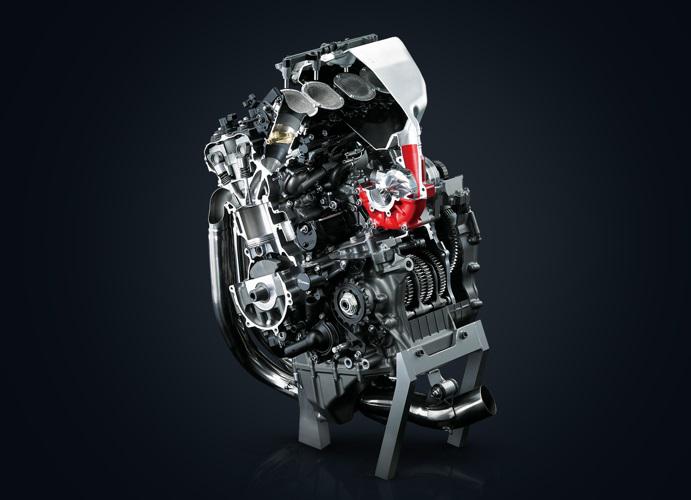
Supercharged engine
Designed completely in-house, the immense potential of the highly compact, highly efficient supercharged engine is a testament to the technology possessed by the KHI Group.
WALK Mode (with Reverse)
WALK Mode assists with maneuvering in a parking lot. When engaged, opening the throttle moves the bike forward at walking speed. Closing the throttle past the “zero” point moves the bike in reverse.
Zero Emissions
When operating exclusively using the electric motor, no emissions are created.
ACC (Adaptive Cruise Control) maintains the speed set by the rider, but adjusts the vehicle speed to maintain a suitable following distance from the vehicle in front.
A more advanced version of Electronic Cruise Control, ACC maintains the speed set by the rider, but adjusts the vehicle speed to maintain a suitable following distance from the vehicle in front. A front-facing radar sensor uses millimetre-wave radar to scan ahead in the rider’s lane. The system takes into account the proximity of the vehicle ahead, degree of road slope, front/rear wheel speed, and the rider-selected distance setting (Near, Medium, or Far). When the distance to the vehicle in front is deemed insufficient, the system directs speed to be reduced. When the necessary decrease in speed is not great, this can be accomplished with engine braking; when stronger deceleration is required, the system also activates the brakes. Once more space becomes available, the system directs speed to be increased and the throttle is increased to return to the set speed.
Based on feedback from racing activities, the Assist & Slipper Clutch uses two types of cams (an assist cam and a slipper cam) to either drive the clutch hub and operating plate together or apart. Under normal operation, the assist cam functions as a self-servo mechanism, pulling the clutch hub and operating plate together to compress the clutch plates. This allows the total clutch spring load to be reduced, resulting in a lighter clutch lever feel when operating the clutch. When excessive engine braking occurs as a result of quick downshifts (or an accidental downshift) the slipper cam comes into play, forcing the clutch hub and operating plate apart. This relieves pressure on the clutch plates to reduce back-torque and helps prevent the rear tyre from hopping and skidding. This race-style function is particularly useful when sport or track riding.
Late-model sport bikes often use large-bore throttle bodies to generate high levels of power. However, with large diameter throttles, when a rider suddenly opens the throttle, the unrestricted torque response can be strong. Dual throttle valve technology was designed to tame engine response while contributing to performance.<br />On models with dual throttle valves, there are two throttle valves per cylinder: in addition to the main valves, which are physically linked to the throttle grip and controlled by the rider, a second set of valves, opened and closed by the ECU, precisely regulates intake airflow to ensure a natural, linear response. With the air passing through the throttle bodies becoming smoother, combustion efficiency in improved and power is increased.<br />
Unique to Kawasaki’s EV and HEV models, e-boost allows riders to briefly tap into extra power for stronger acceleration and a higher top speed. <br>
To prevent battery overheating, e-boost operation is limited (time varies by model). When all conditions have been met, e-boost availability will be shown on the screen via indicator or the e-boost gauge. Pressing the button on the right handle activates the function, increasing power and torque. The e-boost gauge (now purple) counts down the remaining time available. Once the bike is ready again, the e-boost function can be activated once more.
e-boost can be activated on-the-fly (while riding) or when stopped.
Using high-precision electronic control for engine management, Kawasaki models can achieve a high level of fuel efficiency. However, fuel consumption is greatly affected by throttle use, gear selection, and other elements under the rider's control. <br><br>
The Economical Riding Indicator is a function that indicates when current riding conditions are consuming a low amount of fuel. The system continuously monitors fuel consumption, regardless of vehicle speed, engine speed, throttle position and other riding conditions. When fuel consumption is low for a given speed (i.e. fuel efficiency is high), an "ECO" mark appears on the instrument panel's LCD screen. By riding so that the "ECO" mark remains on, fuel consumption can be reduced. <br><br>
While effective vehicle speed and engine speed may vary by model, paying attention to conditions that cause the "ECO" mark to appear can help riders improve their fuel efficiency – a handy way to increase cruising range. Further, keeping fuel consumption low also helps minimise negative impact on the environment.
Electronic Cruise Control allows a desired speed (engine rpm) to be maintained with the simple press of a button. Once activated, the rider does not have to constantly apply the throttle. This reduces stress on the right hand when travelling long distances, enabling relaxed cruising and contributing to a high level of riding comfort.<br />
Kawasaki's fully electronic throttle actuation system enables the ECU to control the volume of both the fuel (via fuel injectors) and the air (via throttle valves) delivered to the engine. Ideal fuel injection and throttle valve position results in smooth, natural engine response and the ideal engine output. The system also makes a significant contribution to reduced emissions. Electronic throttle valves also enable more precise control of electronic engine management systems like S-KTRC and KTRC, and allow the implementation of electronic systems like KLCM, Kawasaki Engine Brake Control, and Electronic Cruise Control.
KCMF monitors engine and chassis parameters throughout the corner from entry, through the apex, to corner exit modulating brake force and engine power to facilitate smooth transition from acceleration to braking and back again, and to assist riders in tracing their intended line through the corner. KCMF oversees the following systems (where available): KTRC (including traction, wheelie and sliding control), KIBS (including pitching control), Kawasaki Engine Brake Control
The Kawasaki Engine Brake Control system allows riders to select the amount of engine braking they prefer. When the system is activated, the engine braking effect is reduced, providing less interference when riding on the circuit.
Designed to assist riders by optimising acceleration from a stop, KLCM electronically manages engine output to prevent wheelspin when moving off. Riders can choose from three modes, each offering a progressively greater level of intrusion. Each mode allows the rider to leave from a stop with the throttle held wide open. With the clutch lever pulled in and the system activated, engine speed is limited to a determined speed while the rider holds the throttle open. Once the rider releases the clutch lever to engage the clutch, engine speed is allowed to increase, but power is regulated to prevent wheelspin and help keep the front wheel on the ground. (In Mode 1, the least intrusive, the front wheel may lift a little.) The system disengages automatically at 150 km/h or when the rider shifts into 3rd gear.
Designed to help riders maximise their acceleration on the circuit by enabling clutchless upshifts with the throttle fully open, KQS detects that the shift lever has been actuated and sends a signal to the ECU to cut ignition so that the next gear can be engaged without having to use the clutch. On models that offer clutchless downshifts, during deceleration the system automatically controls engine speed so that the next lower gear can be selected without operating the clutch.<br />
Kawasaki Smart Reverse with Deceleration electrically deploys the reverse bucket. Activated with a thumb switch on the right handle, it enables thrust to be controlled with one hand.
Pushing the thumb switch fully deploys the reverse bucket and applies thrust, causing the JET SKI to reverse. Pushing the switch farther increases the thrust. Fully deploying the reverse bucket when moving forward contributes to deceleration.
In addition to “Forward” and “Reverse” modes, a “Neutral” drive mode, where the reverse bucket is partially deployed, helps keep the JET SKI in place when idling.
Kawasaki Smart Steering provides steering assistance even when the throttle is not being applied, under certain conditions. The system detects the rider’s steering input as well as the speed of operation and automatically increases engine speed to provide additional thrust when necessary.<br><br>
Through continuous monitoring of engine rpm, this advanced computerised system determines if the PWC is being operated at low or high speed. At low speed, the system does not operate; at high speed, when steering input is detected the system will operate, even if the throttle has been released and the engine has returned to idle. <br><br>
Riders familiar with PWC operation may not notice the system at all since they understand that throttle application is required during turning. But for riders who are learning to negotiate turns and manoeuvre, Kawasaki Smart Steering will be there to assist them.
KTRC, Kawasaki's advanced traction control system provides both enhanced sport riding performance and the peace of mind to negotiate slippery surfaces with confidence. Multiple rider-selectable modes (the number of modes varies by model) offer progressively greater levels of intrusion to suit the riding situation and rider preference.
Less intrusive modes maintain optimum traction during cornering. Designed with sport riding in mind, they facilitate acceleration out of corners by maximising forward drive from the rear wheel. And because Kawasaki’s sophisticated software bases its dynamic analysis on the chassis’ orientation relative to the track surface (rather than relative to a horizontal plane), it is able to take into account corner camber, gradient, etc, and adapt accordingly.
In the more intrusive modes (and for some models, in any mode), when excessive wheel spin is detected, engine output is reduced to allow grip to be regained, effectively enabling riders to negotiate both short, slippery patches (train tracks or manhole covers) and extended stretches of bad roads (wet pavement, cobblestone, gravel) with confidence.
Models equipped with IMU incorporate chassis-orientation feedback to offer even more precise management.
In motocross racing, getting a good start is critical: a few tenths of a second can make the difference between getting the holeshot or not. In low-traction conditions, getting the maximum drive from a motocrosser requires precise control of the both the clutch and throttle. <br><br>
Launch Control Mode helps riders get a good start by complementing high-level technique with engine management. Featured on a mass-production motocrosser for the first time on Kawasaki's 2012 KX450F and now a standard feature on most full-size KX models, the system activates a separate set of maps designed to get a more efficient start off the line. The system is similar to that used by our factory racers competing in the AMA Supercross and Motocross championships. <br><br>
Launch Control Mode is activated using buttons on the handlebar. It uses dedicated KTRC, ignition and fuel maps to provide optimum control to maximise tyre grip, providing the support to help riders get strong race starts. Launch Control Mode is only active in the first two gears after the launch, disengaging and returning to the standard engine map automatically once the rider shifts into 3rd gear.
Models equipped with multiple Power Modes offer riders an easily selectable choice of engine power delivery to suit riding conditions or preference. The number of modes vary by model, as do the types of modes available. Some modes limit maximum power, while others offer milder (or sharper) throttle response. Other modes cater to specific riding or driving situations.
S-KTRC, Kawasaki's original predictive traction control, uses the same base technology as Kawasaki’s works machines. Designed to maximise acceleration, it allows riding at the edge of traction on the track. This technology continually controls the rear wheel slip that occurs when power is applied, ensuring optimal acceleration. In general, maximum forward drive requires a certain amount of slip. To ensure the most effective transfer of power to the tarmac, S-KTRC monitors the slip ratio in real time, and governs engine power delivery to optimise rear wheel traction.<br />S-KTRC monitors a number of parameters, including front and rear wheel speed (slip), engine rpm, throttle position and acceleration. Conditions are confirmed every 5 milliseconds, at which time the system looks at each of the parameters as well has how much they are changing (i.e. their rate of change). This unique Kawasaki method makes it possible to make interpolations and precisely calibrate engine output to suit traction conditions. By acting before slippage exceeds the limits of traction, drops in power can be minimised, resulting in ultra-smooth operation.<br />Because the sophisticated software bases its dynamic analysis on the chassis’ orientation relative to the track surface (rather than relative to a horizontal plane), it is able to take into account corner camber, gradient, etc, and adapt accordingly. It also automatically adjusts for tyre wear, different tyre profiles, high-grip tyres, and numerous other factors that setting-type systems treat as fixed parameters. Models equipped with IMU incorporate chassis-orientation feedback to offer even more precise management.<br />
Clever technology enables riders to connect to their motorcycle wirelessly. Using the smartphone application RIDEOLOGY THE APP a number of instrument functions can be accessed, contributing to an enhanced motorcycling experience. Vehicle information (such as the odometer, fuel gauge, maintenance schedule, etc) can be viewed on the smartphone. Riding logs (varies by model, but may include GPS route, gear position, rpm, and other information) can be viewed on the smartphone. When connected, telephone (call, mail) notices are displayed on the instrument panel. Riders can also make changes to their motorcycle instrument display settings (preferred units, clock and date setting, etc) via the smartphone. And on certain models, it is even possible to check and adjust vehicle settings (such as Rider Mode, electronic rider support features, and payload settings) using the smartphone.
Kawasaki has long had a reputation for building great-sounding bikes – a characteristic inherent in Kawasaki’s engine architecture – but it is only recently that effort has been put into crafting a specific auditory experience though careful sound tuning of either the intake or exhaust system.<br>
Designed specifically to allow riders to enjoy their motorcycles aurally as well as physically, the carefully crafted auditory notes can be the key components of the street riding exhilaration offered by models that have benefitted from sound tuning. Sound tuning can include conducting sound research, designing intake and exhaust system components based on acoustic test carried out in a sound room, and careful consideration of every detail of a system’s components to ensure a balance of performance and the desired sound.
Drawing on the know-how and technology possessed by the KHI Group, Kawasaki’s supercharged engine delivers high engine output while maintaining a compact design. The key to achieving this incredible performance lies in the engine’s supercharger – a motorcycle-specific unit designed completely in-house with technology from Kawasaki’s Gas Turbine & Machinery Company, Aerospace Company and Corporate Technology Division.<br />One of the greatest benefits of designing the supercharger in-house and tailoring its design to match the engine’s characteristics was that engineers were able to achieve high-efficiency operation over a wide range of conditions – something that would not have been possible by simply dropping in or trying to adapt an aftermarket automotive supercharger.<br />The importance of high efficiency in a supercharger is that, as the air is compressed, power-robbing heat gain is minimal. And while many superchargers are able to offer high-efficiency operation in a very limited range of conditions, Kawasaki’s supercharger offers high efficiency over a wide range of pressure ratios and flow rates – meaning over a wide range of engine speeds and vehicle speeds. This wide range of efficient operation (similar to having a wide power band) easily translates to strong acceleration. The supercharger’s high efficiency and minimal heat gain also meant that an intercooler was unnecessary, greatly saving weight and space, and enabling the engine’s compact design.<br />
This convenient mode assists with maneuvering in a parking lot. When engaged, opening the throttle moves the bike forward at walking speed. Closing the throttle past the “zero” point moves the bike in reverse.<br>
With the bike stopped and the throttle closed, WALK Mode is activated by pressing and holding the WALK Mode button. Once activated, the screen background turns orange to clearly distinguish from normal operation.
When operating exclusively using the electric motor, no emissions are created.